
Transforming AI Workflows through MCP
Empowering autonomous AI agents to drive seamless, intelligent operations.

*Disclaimer: The content of this newsletter reflects my personal views and opinions. It does not represent the official stance or viewpoints of my employer.
What if your AI could do something as straightforward as posting to Teams or Slack - or as complex as orchestrating your entire project workflow without the complications of coding an API integration?
Sounds fascinating, right? That’s the shift underway. Instead of programming every single instruction, we can simply say what we want done and AI agents figure out how to do it.
While the web is flooded with articles on MCP, I will showcase a simple, hands-on demo that not only shows you how MCP works in real-time but also reveals its practical applications in business. For those who’ve followed my previous editions—where I showcased task-based agents, retrieval agents, and multi-agentic systems—this is the next step forward. Today’s demo builds on those ideas by integrating MCP with Slack using AutoGen to showcase a real-world use case that’s both accessible and full of creative possibilities.
What Is MCP, Really?
MCP is a standardized method that lets AI agents interact with real-world tools—be it Teams, Slack, Notion, Jira, or another system—without the headache of writing endless API code.
With MCP, you describe a tool once using a shared schema. Then the AI can:
• Discover available tools dynamically,
• Select the right one for your goal,
• And execute the task seamlessly—all while keeping track of memory and security.
This means we are no longer chained to building separate API wrappers for every new function. Instead, we define capabilities that AI agents can leverage as modular building blocks for more complex workflows.. Below is a simple illustration of how an agent utilizes MCP to perform user task.
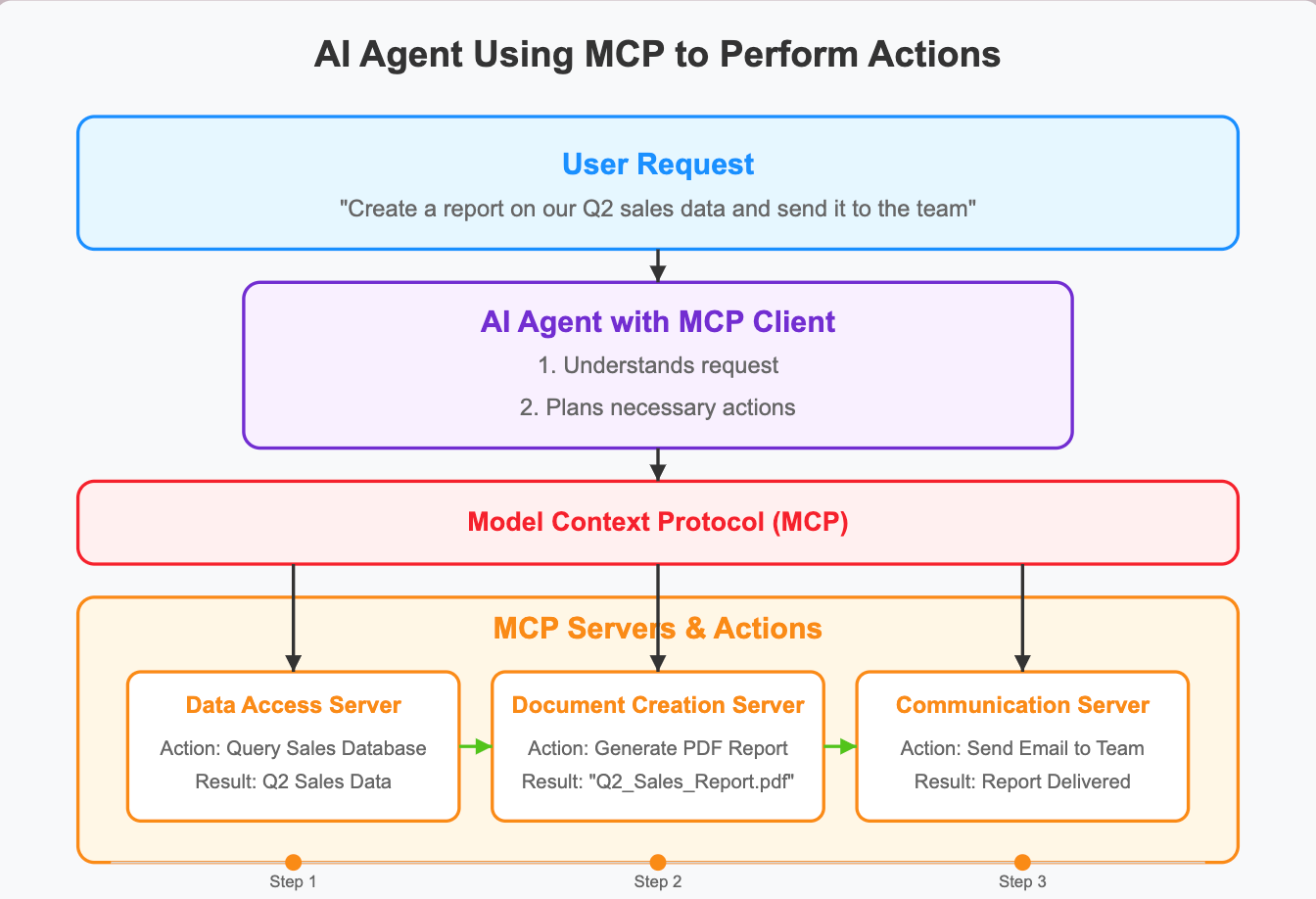
Now, Let’s Dive Into the Demo.... The Slack Use Case: Unleashing Creativity with MCP
Imagine having an AI assistant that not only interacts with Slack but does so in a way that’s engaging and fun. Traditional methods would require you to write individual API calls for each function—posting messages, fetching history, adding reactions, and more. With MCP, however, you simply articulate your intent.
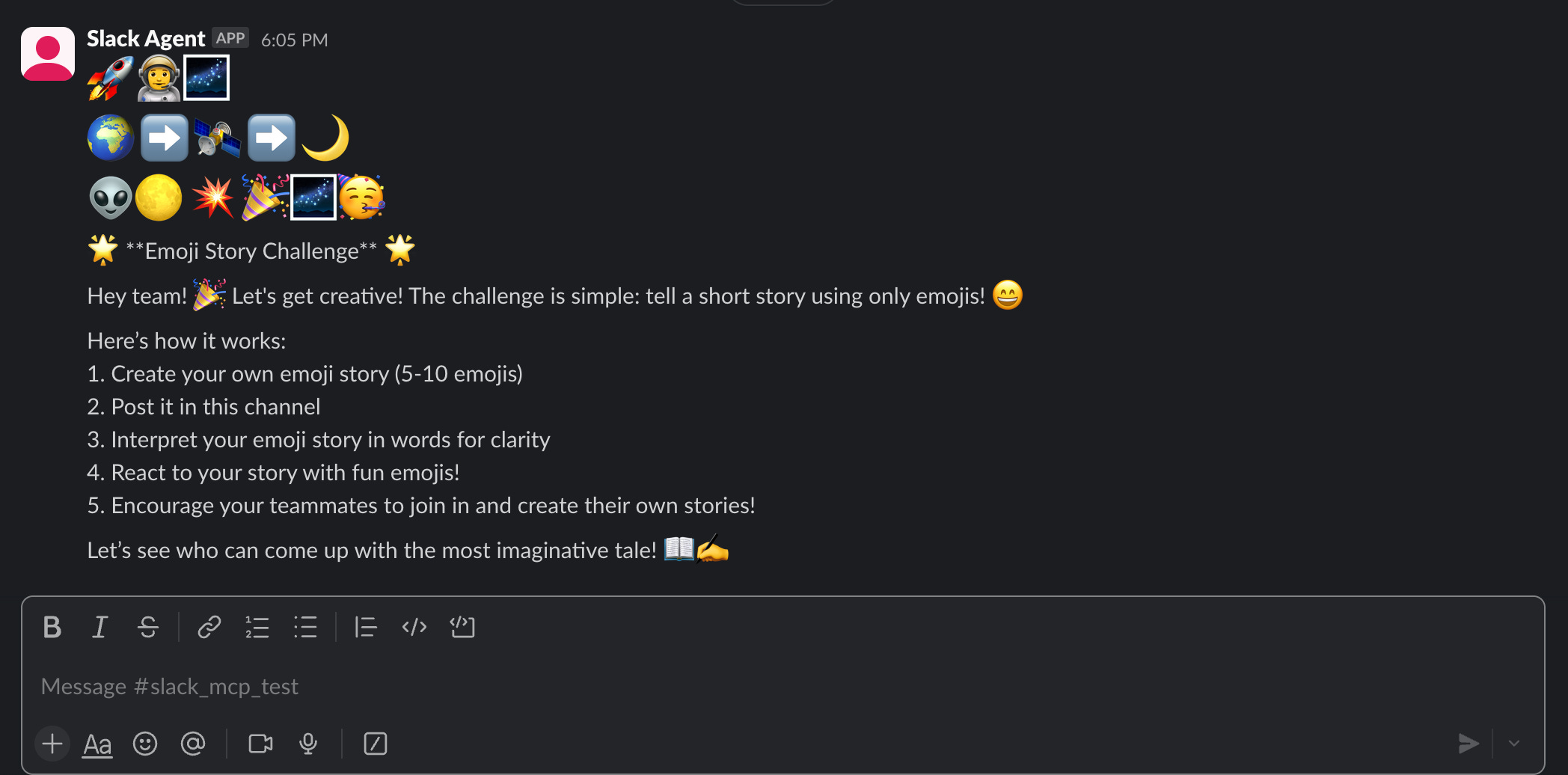
In my demo, I implemented an “Emoji Story Challenge.” Instead of posting a simple greeting, the agent:
• Creates an engaging story using only emojis:
It posts a narrative composed of icons and follows up with a creative interpretation.
• Encourages team participation:
It invites team members to create their own emoji stories, sparking creativity and engagement.
• Demonstrates multiple Slack functionalities:
The demo seamlessly combines rich message posting, adding reactions, and even analyzing conversation history, all orchestrated by the agent.
This approach not only simplifies the integration process but also underscores the potential for AI to transform how teams interact and collaborate.
Key Code Snippet: MCP + Slack Integration
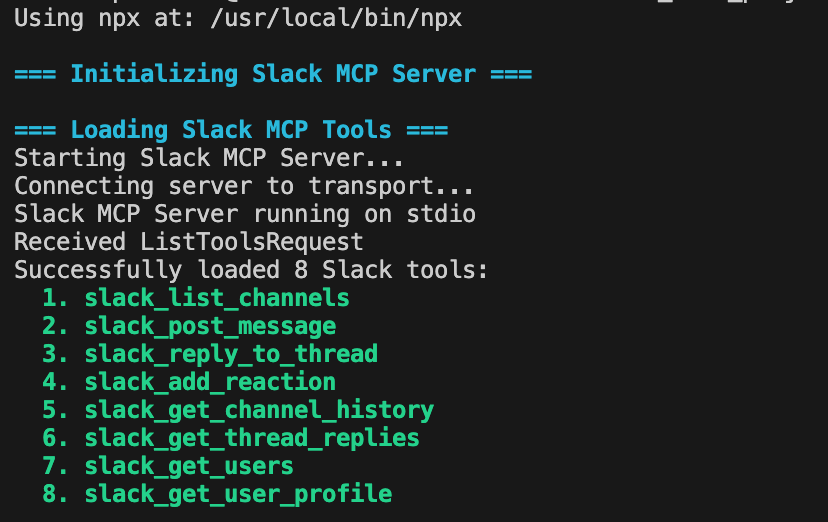
Registering Slack Tools via MCP

Creating the Slack Agent with AutoGen

Executing a Task (Example: ‘Emoji Story Challenge’)

This snippet highlights the core flow: setting up MCP with Slack, creating an AI agent via AutoGen, and issuing a natural-language task. Notice how this approach abstracts away the complexity of writing separate API code for each new function.
Credit: This demo leverages the innovative capabilities of AutoGen to seamlessly bridge MCP and Slack, transforming how we interact with collaborative tools.
Slack Output: The Emoji Story Challenge
You can also view the complete toolkit available to the agent through MCP:
How MCP Supercharges Multi-Agent Collaboration
For those who have followed my previous editions on task-based, retrieval, and multi-agentic systems, MCP is the next leap forward. Picture a collaborative environment where:
• Data Agents fetch and process information from various business systems.
• Policy Agents ensure compliance and parse critical documents.
• Communication Agents manage interactions via Slack or other platforms.
• Planner Agents orchestrate overall workflows and coordination.
Each agent is empowered by a set of tools defined through MCP, keeping their operations modular, secure, and highly adaptable. This synergy enables dynamic, real-world interactions without the rigid constraints of hard-coded APIs.
Practical Business Applications
Leveraging MCP and smart AI agents isn’t just a technical upgrade - it can fundamentally transform business operations. Here are some concrete ways these technologies can be applied:
• Intelligent Sales Assistants:
AI agents can automatically pull CRM data, analyze market trends, draft personalized outreach emails, and update systems in real time.
• Optimized Operational Workflows:
Automated systems extract key metrics, prepare dynamic reports, and trigger alerts when anomalies occur - streamlining processes and accelerating decision-making.
• Customer Support and Engagement:
Smart agents manage customer inquiries, retrieve support documents, draft responses, and route issues appropriately across multiple channels.
• Advanced Data Analysis and Reporting:
Collaborative agents gather data from various sources, perform real-time analytics, and generate visually engaging reports to guide strategy.
• Automated Market Research:
A team of AI agents can drive continuous market research by:
• Scraping web sources and social media for trends and competitor activities.
• Drafting and deploying targeted surveys to closed groups.
• Aggregating and analyzing gathered data to produce actionable insights.
This dynamic approach turns traditional, periodic market research into an ongoing, adaptive process keeping the business ahead of evolving market trends.
By combining MCP’s ability to abstract tool integrations with the autonomy of AI agents, organizations can reimagine workflows and drive agility, efficiency, and innovation in every facet of their operations.
🧩 Final Thoughts
Imagine a digital team made up of specialized AI agents - each one armed with the right tools to take action and work independently. With a framework like MCP powering these agents, they seamlessly discover, select, and execute the appropriate solutions. Workflows evolve from static routines into dynamic, intelligent processes that tackle real-time challenges head-on. This isn’t just about automation; it’s about reimagining how tasks are managed, boosting efficiency while freeing human minds to focus on innovation. The future of work is here—a digital ecosystem where MCP and smart AI agents collaborate to create a truly agile, adaptive enterprise.